
Basal Cell Carcinoma
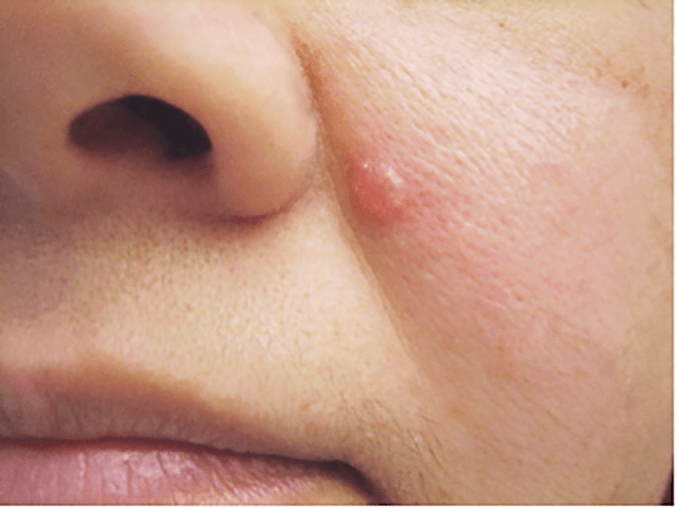
What Is Basal Cell Carcinoma?
Basal cell carcinoma starts when basal cells, found in the deepest layer of the epidermis, begin to grow uncontrollably, usually because of cumulative sun exposure or indoor tanning. It’s classified as nonmelanoma skin cancer, meaning it behaves very differently from melanoma: BCC grows slowly, over months or years, and metastasis (spread to other organs) is extremely rare.
That said, “rarely spreads” doesn’t mean harmless. Without treatment, BCC continues to grow locally, and the longer it goes unaddressed, the more tissue, nerves, and structures it can damage, especially when it develops near the eyes, nose, ears, or lips.
How to Detect Basal Cell Carcinoma
- A pearly, waxy, or translucent bump, often with small visible blood vessels running through it
- A flat, flesh-colored or brownish scar-like lesion with a slightly raised, rolled edge
- A pink or reddish patch that looks scaly or slightly indented
- An open sore that bleeds, oozes, or crusts and doesn't heal within three to four weeks, or one that heals and then reopens
- Most commonly found on the face, ears, neck, scalp, shoulders, and back, the areas that get the most cumulative sun exposure
When Should You See a Doctor?
- A new bump, patch, or sore that hasn't healed within three to four weeks
- A spot that bleeds easily or without any injury
- A sore that seems to heal, then breaks open again
- Any lesion that is slowly changing in size, shape, or color
- You have fair skin, a history of sunburns, or a family history of skin cancer and haven't had a baseline skin exam
What Happens If Basal Cell Carcinoma Is Left Untreated?
Because BCC grows slowly and rarely causes pain, it’s easy to put off getting it checked. But untreated basal cell carcinoma doesn’t stay small. It continues to invade the tissue around it, and around delicate areas like the eyelids, nose, and ears, that growth can destroy cartilage, damage nerves, and lead to significant disfigurement.
The practical consequence of waiting is a bigger, more complex procedure later. A BCC caught early is often removed in a single, relatively simple outpatient procedure with a small scar. A BCC that’s been allowed to grow for months or years may require extensive surgery and reconstruction to repair the area. In rare, longstanding cases, deeply invasive or neglected BCC can also spread to nearby lymph nodes or, very rarely, to distant sites.

The Genesis Dermatology Process
- A visual and dermatoscopic exam of the lesion by a board-certified dermatologist
- A quick in-office biopsy (shave or punch) if the spot looks suspicious, sent to a lab for confirmation
- A follow-up conversation once pathology results are in, walking through your diagnosis and treatment options
- A treatment plan tailored to the size, location, and subtype of the BCC, ranging from surgical excision to Mohs micrographic surgery for areas like the face where preserving healthy tissue matters most
- Most procedures are done on the same day in the office, followed by a personalized schedule of skin checks to watch for recurrence or new lesions