
Forehead Lines
What Causes Forehead Lines?
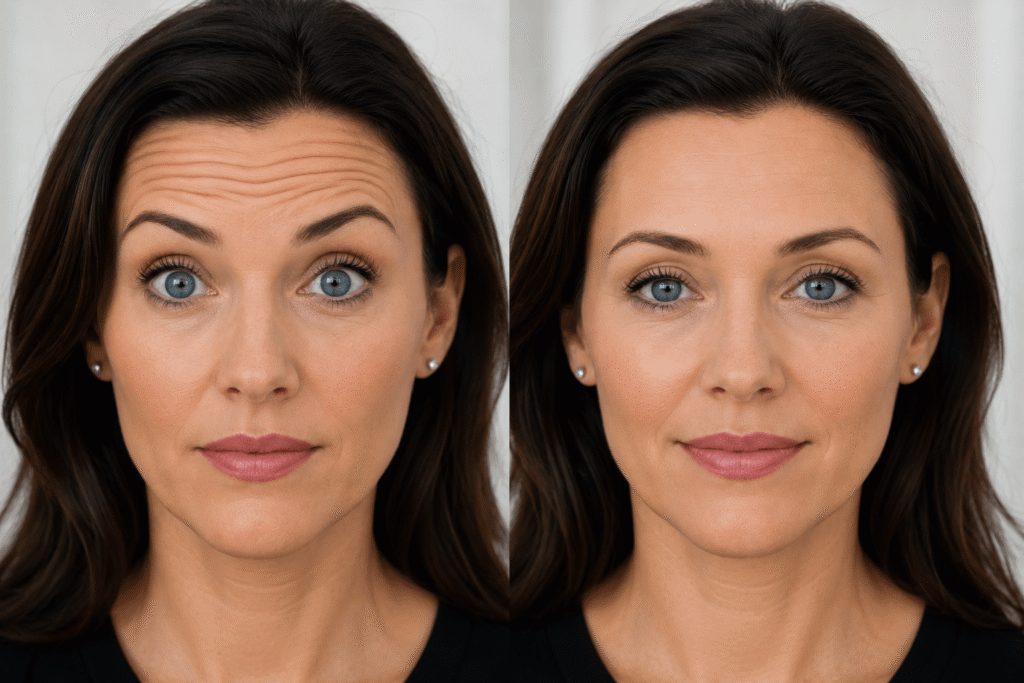
Forehead lines form from repeated contraction of the frontalis muscle, the muscle responsible for raising your eyebrows and creating expressions of surprise or concern. Every time this muscle contracts, it folds the skin above it, and over years of repetition, that folding pattern becomes etched into the skin as a visible line, especially as collagen production naturally declines.
Like most expression lines, forehead lines typically begin as dynamic, appearing only when you raise your eyebrows, and gradually progress to static, remaining visible even when your face is at rest, if the underlying muscle activity isn’t addressed.
How to Detect Forehead Lines
- Horizontal lines across the forehead that appear when you raise your eyebrows
- Lines becoming more visible or taking longer to smooth out after you relax your expression
- Lines that are starting to remain faintly visible even at rest
- A general sense that your forehead looks more textured or less smooth than it used to
When Is It Worth Treating Forehead Lines?
- Forehead lines bother you when you look in the mirror or in photos
- You want a preventive approach before dynamic lines become permanently etched
- Lines are starting to show even when your face is relaxed
- You're interested in a subtle, natural-looking softening rather than a completely frozen appearance
What Happens If Forehead Lines Are Left Untreated?
Because forehead lines are driven by ongoing muscle movement, leaving them untreated means the same folding pattern continues to repeat, day after day, for years. Combined with the natural decline in collagen that happens with age, this repeated folding gradually transitions dynamic forehead lines into static ones that remain visible even when your forehead is completely relaxed.
Once lines become static, treatment with a neuromodulator alone is generally less effective at fully smoothing them, and a combination approach involving fillers or skin resurfacing may be needed for the same level of improvement that would have been achievable with Botox alone at an earlier stage.

The Genesis Dermatology Process
- A consultation to map your specific pattern of forehead movement and discuss your goals
- Treatment with a neuromodulator (Botox, Dysport, or Daxxify) injected directly into the frontalis muscle to reduce the strength of contraction
- A quick, 10 to 15 minute appointment with minimal to no downtime
- Conservative dosing designed to soften lines while preserving natural eyebrow movement and expression
- Results appearing within 3 to 7 days and lasting several months, with maintenance treatments to sustain results over time