
Frown Lines

What Causes Frown Lines?
Frown lines form from repeated contraction of the corrugator and procerus muscles, the muscles between and above the eyebrows that pull them together and downward when you frown, concentrate, or squint. These muscles are used frequently throughout the day, often without you even realizing it, which is part of why this area tends to develop noticeable lines earlier than some other parts of the face.
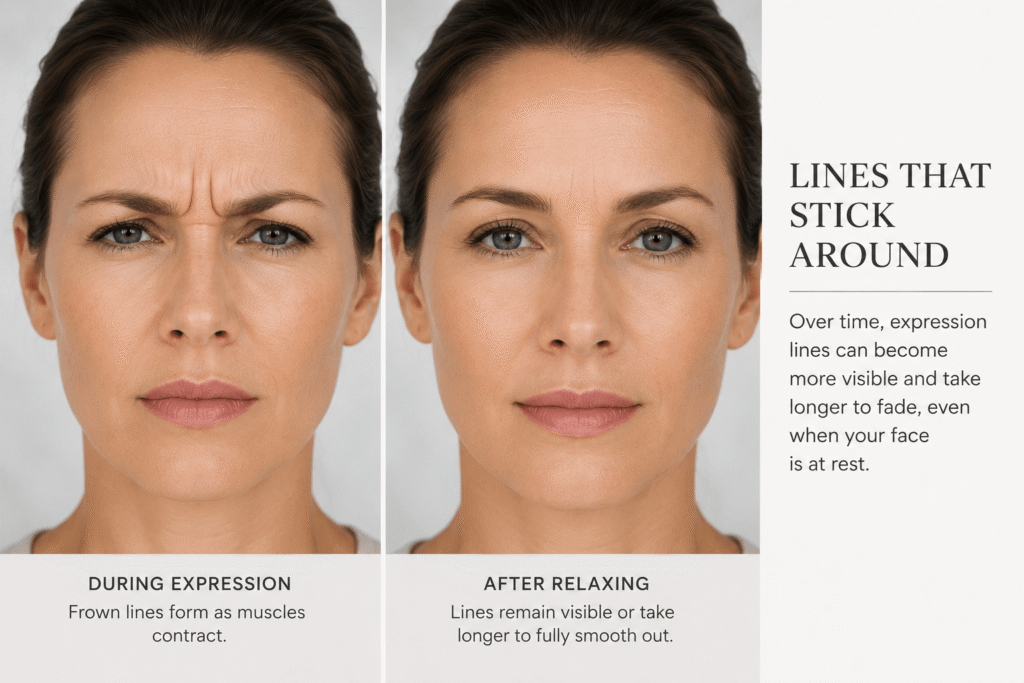
Because frown lines run vertically and involve strong, frequently contracted muscles, they can become static (visible at rest) more quickly than some other expression lines if the underlying muscle activity isn’t addressed.
How to Detect Frown Lines
- One or more vertical lines between the eyebrows that appear when you frown or concentrate
- Lines that make you look angry, tired, or stressed even when you're feeling neutral
- Lines becoming more visible or taking longer to fully smooth out after you relax your expression
- Lines that are starting to remain faintly visible even at rest
When Is It Worth Treating Frown Lines?
- People frequently ask if you're upset or tired when you're actually feeling fine, a common experience with prominent frown lines
- Lines between your brows bother you in the mirror or in photos
- You want to address this area early, since it's prone to becoming static sooner than other expression lines
- You're interested in a natural, movement-preserving softening rather than a completely flat brow
What Happens If Frown Lines Are Left Untreated?
Because the muscles driving frown lines are strong and used frequently, often unconsciously, this area tends to transition from dynamic to static lines faster than other, less frequently used expression muscles. Left untreated, that means the vertical lines between your brows are more likely to become permanently etched at a relatively earlier stage than lines elsewhere on the face.
Once frown lines become static, a neuromodulator alone typically provides less complete smoothing, and combining it with filler to soften the remaining etched line becomes a more common approach than it would have been if treated while the lines were still primarily dynamic.
The Genesis Dermatology Process
- A consultation to assess your specific frown pattern and how the corrugator and procerus muscles are contributing to your lines
- Precise neuromodulator injection (Botox, Dysport, or Daxxify) targeted to these muscles to soften the vertical creases
- A quick, 10 to 15 minute appointment with minimal to no downtime
- Conservative technique designed to soften the "11s" while preserving natural, expressive eyebrow movement
- Results appearing within 3 to 5 days, reaching full effect by about two weeks, and lasting 3 to 4 months before a maintenance treatment is needed